Showing posts with label Reading Notes. Show all posts

Wednesday, November 16, 2016

Reading Notes: Part B of Inayat's Twenty Jataka Tales

Book cover
(source: petama)

As I continue to read these stories, I feel like the stories that are written in a more simplistic sense have a much better chance to get the message across that it's trying to convey. I feel like the stories that have a good amount of length sometimes have the tendency to lose the message.

The patient buffalo was an amazing story. I feel like the message in that all came down to loving everyone. The buffalo did not want to hurt the monkey even though he was causing him pain. He understood that there were reasons in which the monkey acted in this foolish manner.

The goblin town was definitely an interesting one. I'm not sure if it had an exact message to take from it. If I had to guess, I would say that the message is to take truth in the words of your companions when it comes to sketchy situations as they are more than likely looking out for your safety.

The quarrelsome quails was a story with a clear message. The king gave the instructions for the quails to never be caught again. A few of them decided that they would not follow this advice and they were killed while the ones who followed the king's words were never caught and lived happily.

The forest fire story had be going for a second. I was almost determined that the little quail was going to be killed! Luckily, the story conveys the message that even the littlest voice can make the biggest difference and affect the people around him in the largest ways.

---

Bibliography: Inayat's Twenty Jataka Tales
Link to these stories

Monday, November 14, 2016

Reading Notes: Part A of Inayat's Twenty Jataka Tales

Book cover
(source: good reads)

I really enjoy the complete setup that has come with this portion of Jataka Tales. I almost prefer to read them out of the digital book because it provides somewhat of a connection between the stories and I. I think I've gotten more out of the stories when they are presented in this fashion.

The guilty dogs has an extremely scary message. I do not know if this was the intention, but I felt something very uncomfortable while reading it. When the king did not know which dogs to blame, he decided that they should all be killed. This seems somewhat familiar in our international world.

The tortoise and the geese is a story that I've read before, but I think it's somewhat important to write about it again. It seems like this is a representation that our words can be extremely deadly. Literally. The words in this story caused the tortoise to meet his death. We should be careful when we speak.

The golden feathers is another story that I have read with another name. I have also designed a story after this. Like the previous, I think it is important to write about more. It seems that this is basically a warning that there is no need to take advantage of a situation when one is being comfortably fed.

The empty lake was a wonderful story. I saw this as a story of leadership and outspoken fights. The king would not allow his home to be taken from his people, so he called for the forces of nature so bless upon him water. The queen promised that the lake would never parish again.

---

Bibliography: Inayat's Twenty Jataka Tales
Link to these stories

Tuesday, November 8, 2016

Reading Notes: Part B of Rouse's Giant Crab

Book cover
(source: tumblr)

Spend a pound to win a penny was a great story with a personal message. The monkey was so upset that he lost one pea that he ended up losing all of his peas. This story displays a message that if you get to greedy over one thing, you may end up losing everything. Be grateful.

Union is strength is another story with a great message. This tale allows for a message that is somewhat double sided. It's clear that it is trying to convey that there is strength in numbers. However, it also shows that the strength can either help or hurt a group.

Silence is golden was such a sad story. I understand that the cub was intending to scare the other lions, but he still did not deserve to be treated like that. He was just playing around. It was not the cub's fault that he was from a lion but also a jackal. They shouldn't treat him like that.

The quail and the falcon was a pretty solid story. The clear message was that one should not take advantage of the situation they are in if they have a good thing going for them. I was sort of surprised that the falcon was killed by diving into the ground, but I was happy the quail survived.

The bold beggar was easily my favorite story. I love how the king was so self-absorbed he thought his people would like to see him eat. I also loved how clever the beggar was in his pursuit of getting something to eat and drink of substance. I am shocked that the king only laughed.

The two last stories were entertaining to a certain degree simply based on some of the names that were used. I love how the quail was called quailie. It made him sound so cute. I also like how the king decided to call himself king dainty because of his love for food and drink.

---

Bibliography: Rouse's Giant Crab
Link to these stories

Reading Notes: Part A of Rouse's Giant Crab

Book cover
(source: amazon)

To start off this reading assignment, I just wanted to say that I really enjoyed the variety this book had to offer from the other stories. Because it was from an actual copy of a book, there were illustrations in all of the stories which provided an aid for visualization in all of these stories.

I liked the story of the giant crab. The crab was a murderer as he would take these innocent animals that were drinking from the lake and drown them. He would also eat them after he drowned them. I was hoping he would die because I felt it was sad that the animals didn't have anywhere to drink.

The hypocritical cat was an interesting read to me because I have read another tale that uses different animals. Instead of a cat, there was a wolf. I forgot what the substitution of the rats were. It's interesting because the plot elements and dialogue are practically the same.

The mouse and the farmer was a pretty good story. I loved the relationship between the two as it showed loyalty and friendship. I thought it was pretty weird that the farmer killed his own cat though because he was bothering the mouse. He could have talked to the cat instead of death.

The talkative tortoise was such a sad story. I was so sad to see that the tortoise died simply because he was talkative. I think any message would definitely believe to follow directions of others and make sure to not talk if the moment one is in presents an improper sense.

---

Bibliography: Rouse's Giant Crab
Link to these stories

Monday, November 7, 2016

Reading Notes: Part D of Shedlock's Eastern Stories and Legends

Book cover
(source: snapdeal)

The Crow that Thought it Knew was so sad. After reading this story, I was surprised that this was the ending that it decided to take. I appreciated the kindness in the warning of the crow to not dive into the water. I'm shocked that the crow decided against this advice!

The Judas Tree was sort of a weird story. I am not very aware of the lesson it was trying to convey. I understand the children were foolish in assuming they were all right about the status of the tree without thinking the incorporate that that all viewed the trees at different stages in its life. I'm just not sure of the message of the story.

The River Fish and Money was also somewhat confusing. The brother was a thief and not a very good person. There was a generous donation to the fish and this had its reward. I was just confused why the spirit warned him to keep it and he gave it to his brother anyway.

The Dreamer in the Wood had no message I'm almost sure. I don't think there was anything. It seemed that Buddha cared more about the animals being safe than there being no bad characteristics of man. I'm not sure, but maybe that was the closest thing to a message.

The Wise Physican had a fantastic message. It was easily my favorite of the reading. Basically, this woman wanted a cure from her dead child. Buddha told her to find an herb from a household with no death. She couldn't find one to show her that natural is natural and abundant.

---

Bibliography: Shedlock's Eastern Stories and Legends
Link to these stories

Wednesday, November 2, 2016

Reading Notes: Part C of Shedlock's Eastern Stories and Legends

Eastern Stories and Legends cover
(source: internetarchive)

The Hawk and the Osprey story was also a variation of another Jataka tale that I've read. I think the most important thing to take from this tale is to take value from friendships. It's important to have these as the strength of friendship definitely has its benefits in everyday life.

The Elephant that Spared Life was also a good tale. I laughed a little at the line that said "And the King, without inquiring what they had done, gave orders to have them all trampled to death by elephants!" just because it seems somewhat extreme. I was happy to see that the elephant decided to not trample the villagers just because it showed he was good as character.

How the Antelope was Caught was somewhat sad. The antelope was just trying to enjoy a new taste for food and suddenly gets trapped in a palace that is much different from that of the forest. It is filled with men that has a scary sense for the antelope. I'm thankful it was let back into the wild.

The Man who Told a Lie was also an interesting story. I understand why the man decided to feel inclined to tell tales of false identity, but it was definitely a foolish choice. I also think that he deserved to be humiliated in front of his peers simply to have some sort of consequence.

The Pupil who Taught his Teacher was a great tale. I think the title is somewhat misleading simply because it was ultimately a test by the teacher to see if his pupil could teach him. I think that is the case, there is always the possibility that I read this story was some confusion.

---

Bibliography: Shedlock's Eastern Stories and Legends
Link to these stories

Wednesday, October 26, 2016

Reading Notes: Part B of Shedlock's Eastern Stories and Legends

Another book cover
(source: amazon)

It is still very assuming to me that every single one of these stories starts with Buddha. At the beginning, it always addresses that Buddha is in the form of an animal which becomes very clear to the reader that such animal is going to have some sort of good fortune.

The horse that held out to the end showed one of great bravery. There was a lot of violence in this story but it did not give the horse any misdirection. Instead, there was definitely a sense of confidence and perseverance that the horse would indeed make it until the end.

The faithful friend story sounds extremely familiar. I am almost positive the same story was in my reading for last week. I think there was a little variation, but the concept and message was the same. This story just illustrates the power of friendship and the effects it can have.

The elephant that was honored in old age was definitely uplifting. I felt so sorry for the elephant as she lost all of her value and honor just because she had grown weak from age. Of course, Buddha pleads a case for the elephant which causes the king to restore the honor.

The mallard that asked too much was so sad! This man just wanted to provide for his family! I really think the mother should have listened to her daughters. If she would have been patient, the family would not have to worry about money at all but greed was her ultimate downfall.

---

Bibliography: Shedlock's Eastern Stories and Legends
Link to these stories

Tuesday, October 25, 2016

Reading Notes: Part A of Shedlock's Eastern Stories and Legends

Eastern Stories and Legends cover
(source: snapdeal)

These stories are a little different that the previous tales that I used for my reading notes. Not only are they longer in length, but there are also figures from Indian culture used. For example, Buddha was mentioned very briefly in the first story of the book.

The story of the Hare that Ran Away was an interesting one. What I took from it is how far the word of gossip can travel. It was really clear that it is dangerous as well as quick in nature. One person can have a whole group believing a false fact.

The hare that was not afraid to die was sort of confusing. I guess that entire point was to illustrate bravery? Buddha is once again in the form of the hare. He was willing to give up his life in order to serve, but this was just a test. Courage seems to be what comes to mind.

The story of the parrot feeding his family was one I liked. Once again, Buddha is in the form of the parrot. It seems that whatever Buddha takes the form of, there is some wisdom from this character that sets the theme of the story. This was one that showed great character.

The spirit that lived in the tree was my favorite story of the first part reading. It was a fantastic simply because it showed a story of sacrifice. Buddha was a tree spirit and he did not want to be cut down because it would kill nature. The king saved the tree for this bravery.

---

Bibliography: Shedlock's Eastern Stories and Legends
Link to these stories

Wednesday, October 19, 2016

Reading Notes: Part B of Babbitt's More Jataka Tales

Jataka Tales cover
(source: ebay)

The hawks and their friends was a fantastic story. I honestly think the message that the story was trying to get across was the importance of friendship. It is difficult to roam the world alone and friends are there to help in one's time of need.

The brave little bowman was a story that just goes to show that big things come in small packages. I think it is interesting that the big man became so arrogant and attempted to get rid of the little bowman even though he wasn't doing any work.

The foolhardy wolf had a very clear message. It seems that it is not wise to abandon a situation in which one is treated with luxury. It is not smart to grow arrogant from benefits and to believe that one can do the tasks of others just because of a false sense of comfort.

The stolen plow story was strange. It says that the traders are great friends but the town trader does not act like a fan in the least. I really like how the village trader was able to spin the situation in his favor to get his plow back. He was not fooled by the town trader's tale.

The lion in bad company story seemed a lot like peer pressure. It seemed like the wolf encouraged a negative behavior that the lion's father disagreed with. The lion became addicted to the negative activity and it eventually resulted in his death.

The wise goat and the wolf story was another of story that resembled the weaker character being much wiser and having the ability to outsmart the stronger character. The wolves were too eager and foolish to successfully fool the wits of the wise goat.

The elephant and the dog story was adorable. This was one of the first stories where the animals were friends and did not watch to hurt each other. I liked how the king practically turned his entire kingdom upside down in search for a wolf only to make his elephant happy.

--

Babbitt's More Jataka Tales
Link to these stories

Tuesday, October 18, 2016

Reading Notes: Part A of Babbitt's More Jataka Tales

Jataka Tales cover
(source: amazon)

The story involving the girl monkey and the pearls has a very interesting lesson to take from it. I feel like it initially may seem like the lesson involves the guard's clever trick. However, it turns out it is more about the girl Monkey's reveal of the pearls. It is always better to keep what you have to yourself even if there are others boasting about. A treasure hidden keeps its valuable when it is not known by the masses.

The three fishes story has a pretty simple meaning. The lesson taken from this tale seems to be that it is always a safe bet to stay in a place where there is comfort. Venturing to parts unknown without taking risks seriously may lead to destruction.

I thought the wolf would outsmart the rats in the story of the tricky wolf and the rats. It turned out that the rats were able to get the last laugh on the wolf. It seems somewhat challenging to take a lesson from this tale. I think this is simply a story of good and evil. Karma seems to be evident here as the wolf takes advantage of the rats' compassion and this causes his death.

I have no idea where to begin with the tale of the stupid monkeys. It may be the gardener's fault for thinking he could trust monkeys to properly water his trees. There was no malicious intent, but the monkeys had no clue how to take care of the trees.

I really enjoyed the story of the cunning wolf. I feel like this is a match of wits. The man was completely outsmarted by the wolf king. The man should have looked for different methods of food rather than believing he could outsmart the animals by the water. His arrogance got the best of him.

The story of the woodpecker and the lion was odd. The woodpecker had a certain sense of entitlement with the lion. The lion seemed somewhat ungrateful for having his life saved. I understand he also saved the life of the woodpecker, but this situation was only created because of the lion's dire need of a savior.

The story of the wolf and the otters was easily my favorite. The otters were extremely greedy when fighting on which side of the fish they should get. Each side was large and equal in size. The wolf was able to take advantage of the situation and show them that greed will get them nowhere.

For my story this week, I think it would be wise to look at the various lessons and situational pieces found in this Jataka tales. I can manipulate one of the stories into my own. I could also use a lesson from one of the tales and use that in my own story.

--

Babbitt's More Jataka Tales
Link to these stories

Tuesday, October 4, 2016

Reading Notes: Part B of Epified's Mahabharata

Drona approaching the Pandavas
(source: Youtube)

I really like the fact that some of the videos have a little introduction at the beginning called the story so far. It was nice to get to view that before starting today's reading notes so I was refreshed on the topic at hand. Even though they are not crucial, it is definitely a great luxury to have them.

The entire scene with Kunti summoning the god of the sun was exceptional. It allowed me to have a better visualization of what was actually happening. She was so startled that the summon actually worked and she was embraced by the god. You could see the emotion through the art and I loved it.

The narrator suddenly changing threw me off quite a bit. It's not really that important but it was interesting that the voice over suddenly as a complete change. The art style remains constant and that is all that really matters when watching these videos.

The display of Pandu's curse looked a little funny to me. Basically, Pandu murders this couple by sending an arrow through their bodies. I guess it just looks a little strange because it's extremely difficult to depict the arrow going through both bodies without a some flaws. Pandu's face is absolutely priceless.

The birth of the Pandavas was such an exciting video to watch. Kunti just starts summoning god after god and children are just being produced at a rapid pace. It's interesting getting to see the creation of these beings at the moment after knowing what ultimately happens to them later on in the story.

Bhishma makes another appearance as being the stand in father figure. It's odd because Bhishma seems like he is instantly given responsibilities after he is introduced as a character and he is constantly at work. It was nice getting to see Drona drawn out as I was curious how he would be depicted.

Drona training the children was probably my second favorite video of this section of reading notes. We get to start identifying how the Pandavas differ from each other. Each of the children begin separating and really focusing on their true strengths under the expert training of Drona.

---

Bibliography: Epified's Mahabharata
Link to this reading guide

Reading Notes: Part A of Epified's Mahabharata

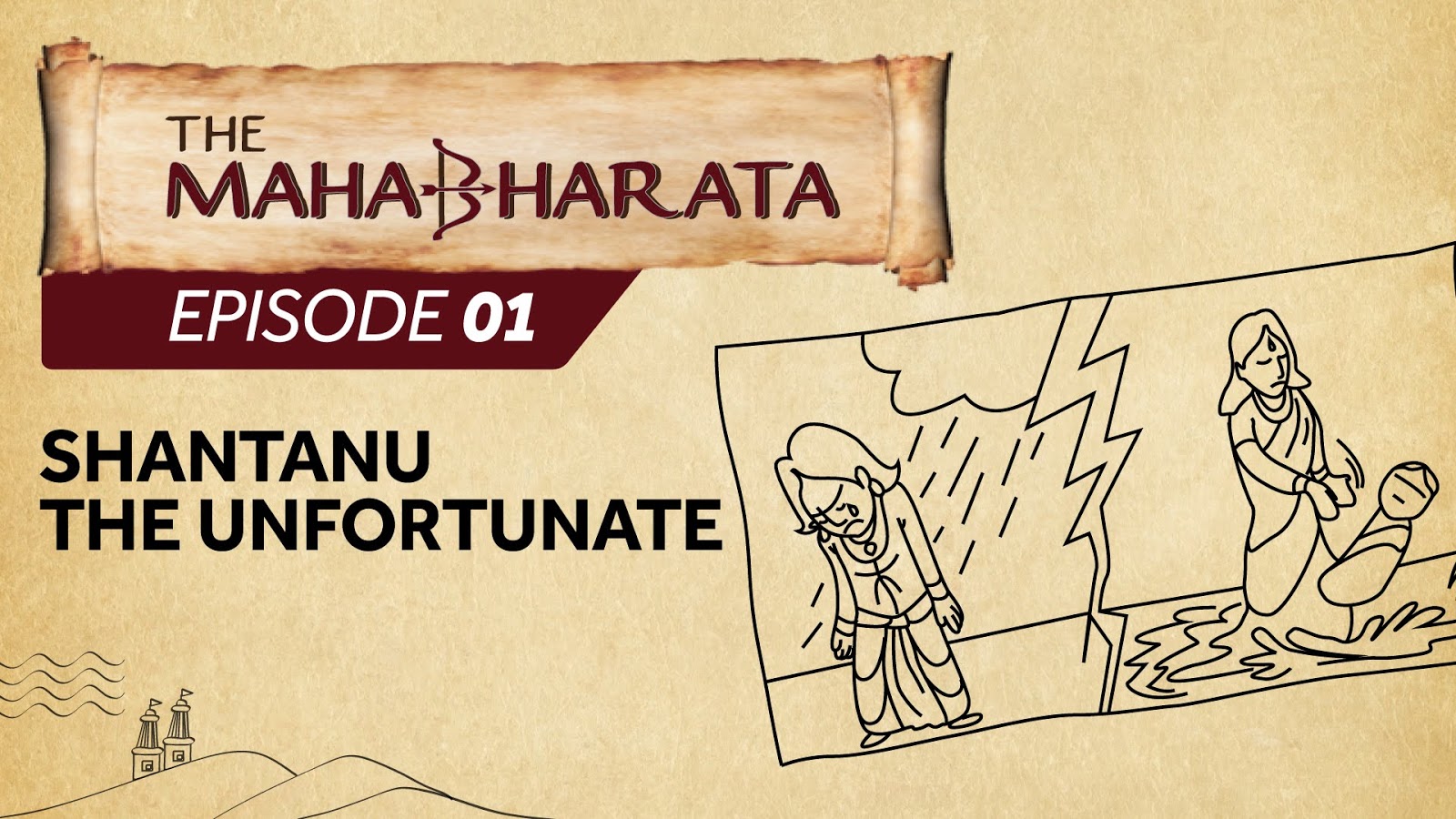
Shantanu's despair
(source: YouTube)

I just wanted to begin these reading notes with expressing my excitement with the portrayal of this series. Watching this first series has allowed myself to get a better understanding of the epic through the use of hand drawn pictures. I am very content with this reading choice.

I actually felt bad for Shantanu after watching the first video mainly because of the drawing style of the artist. Shantanu looked so incredibly depressed with his single tear dropping down his face. This effect definitely allowed me to sympathize with him.

Continuing with the details surround Shantanu, I had great joy in seeing happiness bestowed upon him after all this time. He was able to see Ganga again and he was also reunited with his son that was taken from him several years ago. Again, there was a relation of emotion.

The music in these videos was something else. I really enjoyed the start of the epic music that began in the fourth video. There was a sense of suspense as the drawings were happening which mixed in with the music allowed for a more captivating view.

I loved the portrayal of Bhishma kidnapping wives for his half-brother! The art in this was so entertaining for the simple fact that Bhishma looks so determined in his quest for a successor should his brother parish. I love the way he is literally dragging the women out of the court. It's my favorite art piece so far.

I completely forgot about Amba! It was one of the main connections I made between the Mahabharata and the Ramayana as there was a conflict with women spending time in the home of another man. I related Amba to Sita as they were both met by a rejection of sorts.

In this series of videos Bhishma seems like the ultimate operator behind everything. He is out arranging marriages and raising children as if they were his own. He really is the sort of like the father figure of every character we have met and he's trying to make everyone happy. This is very selfless of character.

---


Bibliography: Epified's Mahabharata
Link to this reading guide

Tuesday, September 27, 2016

Reading Notes: Part D of Narayan's Mahabharata

Bhima after killing Duhshasana
(source: tostrength)

There is a certain sadness to this opening of the reading simply because the Pandavas are still very hesitant about this upcoming war. Eventually, they realize that is it practically unavoidable and there best option is to engage so there are not at a disadvantage.

Death is everywhere. It's odd to read about these characters being killed off one by one after reading about them for such a long time. I understand that this was bound to happen, but there seems to be much more death than that of the Ramayana.

Continuing a small comparison to the Ramayana on the topic of deaths, it seems like there is much more violence in this epic. The deaths are overly violent which isn't necessarily a bad thing, but it's definitely a change of pace from the previous reading.

Bhima sort of lost me after his murder of Duhshasana. The death didn't bother me but the actions that followed seemed a little extreme. It didn't necessarily disgust me, but I guess I was just caught off guard with the violence post-death.

After reading the end of the war, I was really impressed with the suspense that was created and successfully carried out in a way that should satisfy the reader. There was so much going on during the battle that my levels of engagement were top-notch.

Dragging in another comparison from the Ramayana, it seems like life after the war in this epic was just as chaotic after the war. There seemed to be somewhat a sense of peace after the great battle in the Ramayana. In the Mahabharata, many deaths followed which was interesting.

Overall, I definitely think this was a lesser favorite of mine. I had a little harder of a time keeping up with the characters as well as the family ties in this epic. It was not as clear-cut as the Ramayana. However, I did enjoy the epic as there always seemed to be tension which is my preference in reading.

---

Bibliography: Narayan's Mahabharata
Link to this reading guide

Reading Notes: Part C of Narayan's Mahabharata

Bhima killing Kichaka 
(source: pinterest) 

I thought the entire situation involving Duryodhana was excellent. It was a pure joy to read simply because I love reading about subject matters that involve the art of backfire. The entire ordeal was amusing because Duryodhana was so desperate for his act of belittlement that he absolutely gets destroyed in the process. The icing on the cake was the method of his freedom.

The lake portion might have been my favorite up to date simply because it was outrageous. I didn't expect the siblings to be killed simply because I thought if they were to die, it would be in the hands of their enemy family members. Their resurrection was shocking as well but ultimately I'm happy it happened as a more progressive indication of more variety in their deaths.

I reminded somewhat of a scene from Harry Potter  when the siblings were visually altered after their resurrection from the death in the lake. This was to use as a tool to aid them. Harry was also given this so he would not be recognized by the death eaters.

Bhima has a moment in this section of reading that was particularly needed. He still remains my favorite character and he completely confirmed this fact based on his actions. His murder of Kichaka as a punishment of rape was utterly heroic and I commend him.

Excitement is starting to grow as a reader based on the anticipations of war. It was really easy for me to visualize the scene at the wedding where it was known that the war was on the brink of the horizon. The recruitment of allies really forces those to choose a side.

I was somewhat surprised to see the Pandavas be so keen on keeping the peace. At the end of the last section, the recruitment of weapons of weapons seemed to allude that they were ready for war. It is somewhat warming to see that they would rather there be no bloodshed.

There is a sense of suspense as this epic is about to conclude. I'm really hoping that there will be lives spared but I'm afraid there is going to be events that involve a plethora of deaths. I'm not sure I'm prepared to read the conclusion of this story.

---


Bibliography: Narayan's Mahabharata
Link to this reading guide

Wednesday, September 21, 2016

Reading Notes: Part B of Narayan's Mahabharata

Yudhishthira gambling away Draupadi
(source: wikipedia)

This story honestly just seems like one battle among family members. I'm pretty sure everyone is related to each other in at least some way at this point. It's entertaining as families, especially large ones, tend to definitely have their feuds among blood.

Karna going ballistic over any potential for peace is an absolute representation of the history of man. Not only does he refuse peace, but he also wants there to be a war. This fact just further proves my point as this is a continuous cycle haunting mankind.

There was enjoyment found in making a certain connection. When Dhritarashtra granted the Pandavas the ability to build their city, they decided to name it Indraprastha. Among the Pandavas is Arjuna who is the son of the god Indra. Even though it's obvious, it's still a nice connection to make.

It's still amusing to see how easily marriage is tossed around in these stories. It seems like every character absolutely has to have a wife. This point was made even more obvious when Arjuna is exiled and during his exile he marries two women.

The dice game was really alarming. I guess I wasn't expecting the correct things but it just seemed like it wouldn't escalate as much. I understand that revenge was at play but the events of the game really got out of hand and I was so surprised to see them unfold.

Since Bhima is my favorite character, I am looking forward to how he will seek his revenge. I'm hoping he will live up to expectations. I will be disappointed if something happens that prohibits Bhima from properly having his revenge.

In seems like I am stopping at such an eventful part of the story. The next part is bound to be filled with nonstop suspense. The Pandavas gearing up to fight over the result of the dice game seemed very intense and things are looking grim for their enemies. 

---

Bibliography: Narayan's Mahabharata
Link to this reading guide

Tuesday, September 20, 2016

Reading Notes: Part A of Narayan's Mahabharata

Bhima, my favorite character
(source: wikipedia)

It was interesting how Shantanu's love for Ganga was depicted. Not only did she request that he dare not question where she was from or her true origin, but she also demanded that he could not question her actions. Any logical man would have vanished from this situation, but Shantanu was determined he was to marry this woman.

When Ganga started drowning her children, I instantly made the relation to Andrea Yates who is notoriously known for drowning her children. It's a terrifying act and just because it happened in fiction, doesn't mean it's immune to occurring in reality.

The interaction between Shantanu and Satyavati was entertaining. Shantanu was still constantly thinking about Ganga and then suddenly that competently vanishes and he is in love with another woman. I enjoy how easily the idea of love is tossed around in these epics.

It was completely shocking to read about Bhishma's act of renouncing his right to the throne. He did it with almost no hesitation. He noticed his father was upset, he contacted the chief fisherman, and then he agreed to renounced his right. This just goes to show how great of a son Bhishma is to his father. Giving up the rights to the throne is a large sacrifice.

Flashbacks of the Ramanya occurred concerning the situation regarding Amba and the king of Shalwa. Just like Rama demanded a test of purity after Sita spent time in another man's home, Amba is rejected for the exact same reason. It's clear this is a rule in strength.

I feel as if there is a lot going on. There just seems to be multiple children being born and the family tree seems to be somewhat massive at this point. It's not a negative, but there is definitely a large family dynamic occurring in this book.

Bhima seems to be emerging as my favorite character at this point in the reading. I enjoy that he is being portrayed as a total strong man that can easily defeat anything that crosses his path. Characters like this always entertain me as they seem invincible.

---

Bibliography: Narayan's Mahabharata
Link to this reading guide

Tuesday, September 13, 2016

Reading Notes: Part B of Nina Paley's Sita Sings the Blues

Sita weeps during her exile

The email that was sent by Dave to Nina was absolutely hilarious. I'm sure that was the intention to make light of an awful situation but its blunt nature along with its subject of 'dumpsville' was highly entertaining. That might be one of the worst ways to be broken up with. It was also worth nothing that he signed off the letter by saying 'love' which was also clever.

Bringing up the fact that Sita could have been impregnated by Ravana instead of Rama due to the quick announcement of the pregnancy was interesting. The narrators are having fun with the topic of Ravana like claiming his pure nature in the first half which was fun to see.

The portrayal of Sita's exile was incredible. Rama seems fine to welcome Sita in his home after sleeping in the home of Ravana until he hears a man below beating his wife for sleeping in another man's home. Rama then basically tells Sita to get lost. It was only because he felt that he had to relate to the common man if he were to rule them,

Sita's animation when she sings the blues during this half was priceless. She's a lot bigger given her pregnant state so she looks like a snake who just swallowed a exercise ball. Meanwhile, her waist is as skinny as can be. I love the art style.

It took me way too long to understand the correlation between the Dave and Nina story and the epic of Rama and Sita. It once I realized that, things became much more clear. It was to add a modern approach to the topics of the Ramayana.

It's still entertaining to me that Rama requires Sita to prove her purity once again. He has basically exiled her for the sake of being respected by his followers and this notion has caused her to mourn and be in pain. It was satisfying to see her leave.

Overall, I am extremely pleased I chose this film for my reading notes this week. I really enjoyed getting to witness something that was more from Sita's perspective after reading the Ramayana. The film did a great job of projecting her sorrows.

---

Bibliography: Nina Paley's Sita Sings the Blues
Link to this reading guide

Reading Notes: Part A of Nina Paley's Sita Sings the Blues

Sita in her first half conclusion
(Source: theroarbots)

As a general remark, this was a very interesting video to watch (at least the first half). It was nice seeing characters from the Ramayana brought to life. There was a lot of variety in the art and animation which is quite rare to see an a film like this. Usually, creators like to stick to one animation and art form but this one bounced around.

The opening sequence with the couple and their cat was very unexpected. I was anticipating to instantly see characters from the Ramayana, but instead there two people living in what appears to be New York City. The animation of this sequence was pretty unique.

The three narrators arguing over the aspects of the Ramayana was highly entertaining to witness. They all had somewhat of an attitude which added some comedic undertones to this film. I enjoyed getting to watch them attempt to explain the epic even though they doubted it.

The narrators continue to explain the story and they are creating such an enjoyable aspect to this film. I really like the pace they decided to run with because it really works in my opinion.

I like how the artwork of the film was similar to the traditional Indian artwork of the Ramayana. However, when Sita broke out into the blues, this was completely eliminated and the animation transformed into something much more modern.

I really liked how one of the narrators basically starting to paint Ravana in a good light. It gave me the impression that were really making the view question the authenticity of his morals.

Ramanaya seems to resemble the genie from the Disney version of Aladin during Sita's singing of the blues episodes. That is at least one of my first thoughts upon seeing this manipulated art.

---

Bibliography: Nina Paley's Sita Sings the Blues
Link to this reading guide


Tuesday, September 6, 2016

Reading Notes: Part D of Narayan's Ramayana

My favorite character, Hanuman
(Source: astrogems)

As the final section is over, I would like to declare this as my favorite out of them all. Since I did not do any work on Monday, I read both sections (C and D) on Tuesday and then published my reading notes. I could not take the idea of stopping the story to write reading notes and then picking it back up. By reading the second half all the way through, I think I was able to fully appreciate the story.

Hanuman became my favorite character by far after reading this last section. The fact that he was growing to incredible sizes and destroying things was extremely entertaining to read. His desolation of Lanka was amazing even though it was rebuilt.

It was very pleasing to read about Ravana's refusal to consider a curse. This is typical villain arrogance and I was excited to encounter it. It just goes to show he was ultimately doomed for considering himself untouchable.

Vibhishana was a pleasant character even though he was the brother of Ravana. I thought it was wise to advise his brother to let Sita free as the curse declare Ravana vulnerable to a human. The fact that Vibhishana was cast away for this ultimately showed the arrogance of Ravana yet again. I was happy to see Rama trust Vibhishana after he confided in him.

It was sort of terrifying to read about Rama's encounter with Sita after the death of Ravana. I can understand why Rama wanted it so, but it was still concerning to read about the orders of a husband to his wife in order to prove a certain truth.

Rama organizing a funeral for Ravana just goes to show the purity of Rama. Ravana was painted as the big, bad villain this entire epic. He even kidnapped Rama's wife. Yet, when Rama defeats him, he still shows compassion even to his darkest of peers.

Overall, I really enjoyed reading the Ramayana. I look forward to working with this particular epic as we dive deeper into the semester as it was an excellent read.

---

Bibliography: Narayan's Ramayana
Link to this reading guide


Reading Notes: Part C of Narayan's Ramayana

The battle between Sugriva and Vali
(Source: Wikipedia)

As a general thought, I thought this portion of reading as it seemed like it was a side story of sorts. Obviously, it was important to the story because it allowed the location of Sita to be discovered after her kidnapping, but I still feel like it could have happened in an simpler way than the chain of events that occurred. That's not to say I didn't enjoy it. It seemed like a change of pace and I definitely appreciated it. It may have actually been my favorite reading just because there was a lot going on and I really enjoyed the conflict.

The monkeys (vanara) that dominated this portion of reading were nothing short of entertaining. It was somewhat comical that Hanuman thought he would get away with a disguise in the presence of Rama. I was hoping it wouldn't fool him because that would discredit Rama's excellence in my eyes. Rama didn't disappoint when he noted the transparency of Hanuman.

Not necessarily a surprising event, but a somewhat concerning outcome was Surgriva's post-crowning. Characters tend to do odd things in this epic and case and point was evident when Surgriva was nothing short of discourteous in aiding Rama in his quest for Sita.

Lakshmana's loyalty and bravery were present yet again when he goes to confront Surgriva on his agreement with Rama. I was happy to see that Surgriva ultimately helps Rama and there was not much of an issue present with this.

The conflict between Sugriva and Vali was my absolute favorite section I've read from the Ramayana. The history behind the two was all over the place. The retrieval of his brother which ultimately resulted in his riddance from the kingdom was a fun read. The fact that he stole his wife was just icing on the cake.

Even though Vali was off-the-wall crazy, I was disappointing to see his death. I wanted a little more out of him, but I understand it was necessary for the story's progression.

---

Bibliography: Narayan's Ramayana
Link to this reading guide